A Container Home in Ukrainian Latitudes: Between a Design Dream and Construction Physics
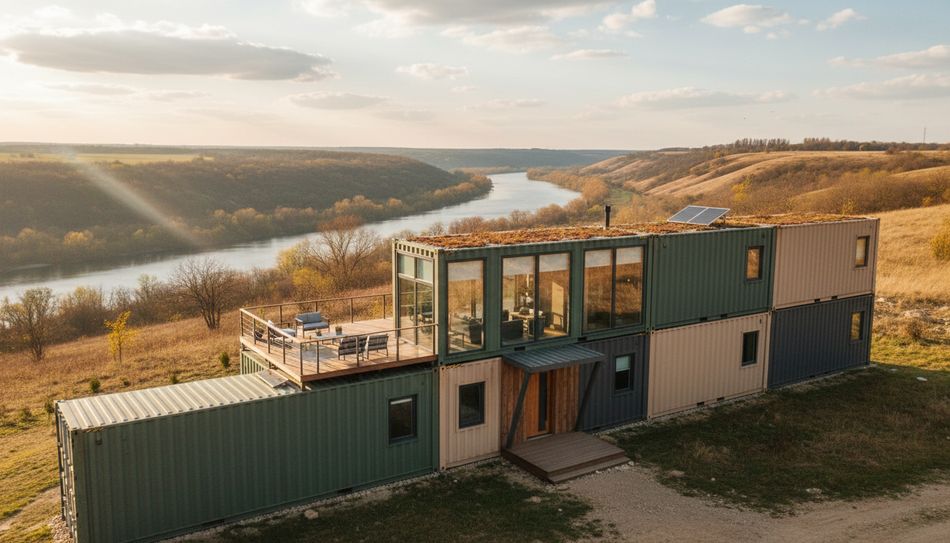
Pinterest pictures paint an idyll: floor-to-ceiling panoramic windows, a cozy terrace, and a stylish metal facade somewhere at the edge of a forest. It seems like an ideal way to get your own home for pennies and in a couple of weeks. But if you plan to turn a shipping container into a cozy nest in our realities, you should immediately take off your rose-colored glasses and figure out how to reconcile a steel box with the Ukrainian winter and hot summer.
The Main Enemy — The Dew Point The main problem of any metal structure is condensation. If you simply line the walls from the inside with drywall and lay insulation, a "stream" will inevitably flow between the metal and the finish. Metal cools down instantly, moisture from the air settles on it, and in a couple of years, you will get rotten cladding and a smell of mold.
There is only one solution here: complete airtightness of the inner contour. Sprayed polyurethane foam (SPF) handles this perfectly. It sticks directly to the iron, leaving no air gaps where moisture could accumulate. The second option is very thorough vapor billing, but the smallest hole from a self-tapping screw can ruin the whole venture. In our latitudes, the insulation thickness should be at least 100 mm, otherwise, in winter you will go bankrupt on heating, and in summer the container will turn into a red-hot oven.
The Myth of "Cheapness" and "Speed" There is an opinion that a container house is many times cheaper than a brick one. This is true only if you are building a summer cottage or a construction shack. If we are talking about a full-fledged home with high-quality finishing, hidden wiring, heated floors, and good windows, then the price per square meter closely approaches the cost of a classic frame house.
The main expenses are not spent on the "iron" itself, but on making it livable:
-
Foundation. Although the container is strong, it cannot just be dropped on the ground. Piles or a pier foundation are needed to ensure ventilation of the bottom.
-
Windows. Cutting openings weakens the structure. To prevent the roof from sagging under snow, openings must be reinforced with a steel channel.
-
Ceiling Height. In a standard module, the interior height after insulating the floor and ceiling will be about 2.3–2.4 meters. That is not enough. Therefore, for housing, you should only buy High Cube models (increased height).
Who Really Needs This? Despite all the difficulties, container construction has a trump card that no brick can beat — mobility and legality. Such a house is formally considered a temporary structure, which in some cases simplifies bureaucratic issues with land. And if circumstances change, the house can (though not without effort) be loaded onto a platform and taken with you.
A container house is a choice for those who appreciate industrial aesthetics and the speed of erecting the "shell." It is a great option for a guest house, a garden office, or compact housing for one or two people. The main thing is to remember that steel does not forgive mistakes in thermal engineering. If you approach the issue wisely and do not save on the little things hidden behind the finish, such a house can become the coziest and most unusual place in the world. Otherwise, it will just remain an expensive iron box.


