How to turn a shipping container into a pool
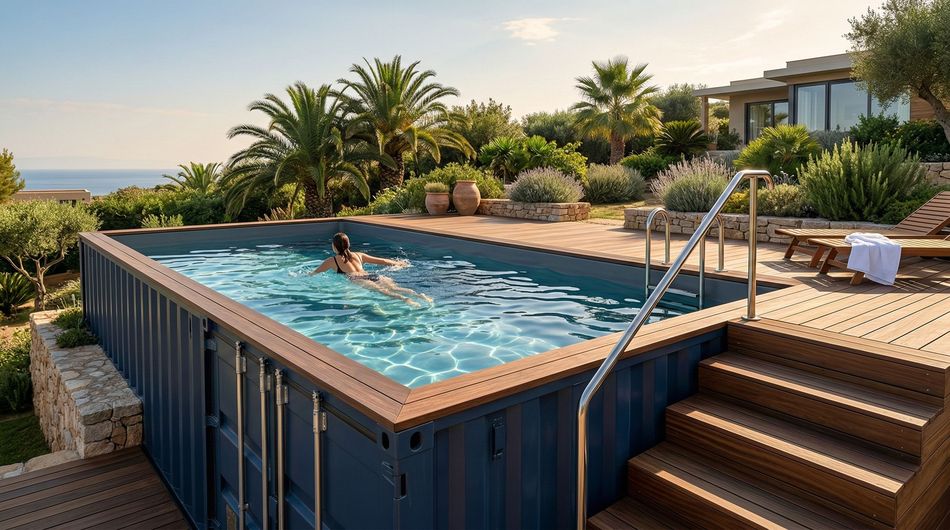
When the real summer heat arrives, the thought of your own body of water on the plot ceases to seem like a luxury and moves into the category of basic needs. But as soon as it comes to implementation, the enthusiasm of many quickly evaporates. A classic concrete pool means months of dirty earthworks, mountains of rebar, concrete mixers, a completely destroyed lawn, and an estimate that has the unpleasant property of growing during the construction process. Inflatable or frame structures made of blue PVC certainly solve the overheating problem, but let's be honest, they look like a temporary compromise and add absolutely no aesthetics to the plot. And here a new trend, coming straight from industrial design, has rapidly burst into the world of suburban landscaping.
Industrial chic instead of boring concrete
It turned out that the perfect geometry and colossal safety margin of a shipping container make it an excellent blank for creating a stylish, durable, and mobile pool. Outwardly, such a structure looks like an expensive loft-style art object. The austere corrugated walls made of alloy steel, painted in a deep matte color (for example, graphite, black, or dark green), combined with clear blue water and a neat wooden deck around the perimeter, create a stunning visual contrast. It is no longer just a swimming tank; it is a full-fledged architectural statement.
The main advantage of such a non-trivial solution is speed and amazing autonomy. The pool is assembled, welded, and tested at the factory, and arrives at your site as an absolutely finished product. A manipulator simply unloads it onto a prepared flat area (ordinary road plates or a shallow strip foundation are perfect for this), you connect the electricity, supply the water — and you can dive in. If in a few years you decide to sell the house or move to another region, your personal beach will not remain a generous gift to the new owners. You just load it onto a trailer in the exact same way and take it with you.
Physics of water and engineering nuances
Of course, in real life, you can't just take an iron box, cut off its roof with an angle grinder, fill it with water from a garden hose, and invite friends to a foam party. Water is a heavy and extremely insidious thing. A standard twenty-foot block holds more than thirty tons of liquid. And if this load is distributed quite naturally over the powerful bottom, the side walls without a roof, which previously served as the main stiffening rib, can simply bend outward under colossal hydrostatic pressure.
Therefore, the transformation process requires a serious engineering approach. A powerful steel frame made of a thick profile pipe must be welded along the upper perimeter of the cut. It tightly pulls the sides together, preventing them from deforming. Next, the issue of reliable waterproofing is solved. Metal, even of the highest quality, should not come into direct contact with chlorinated water. The most popular and durable method is gluing a solid bowl made of multilayer fiberglass inside or welding a hermetic polypropylene insert. Before this, the inner walls are carefully treated with anti-corrosion primers and insulated with sprayed polyurethane foam. It works like a thermos: the water heats up much faster in the sun and cools down much slower on cool nights.
Smart filling in a hidden compartment
Another ingenious feature of such a modular format is the ability to hide all the necessary technical equipment right inside the dimension itself, without disrupting the appearance of the site. Usually, a meter or a meter and a half of the total length is cut off for a small but roomy technical room. Circulation pumps, sand filters, electric heating systems, and automation for chemical dosing are installed there.
Outside, it looks extremely neat: a blank metal wall with a door, behind which the equipment hums quietly. No protruding hoses, wires, and ugly plastic booths next to your sun loungers. You get an absolutely clean, minimalist design. Add to this underwater LED lighting for night swimming, a powerful countercurrent for full-fledged stationary swimming (an excellent cardio workout even in a small volume) — and the old port container turns into a high-tech spa resort, which will become the main pride of your yard.


