What is kept in it
- Spare parts, tools and consumables for machinery — in the machinery yard or right in the field during sowing and harvest.
- Fertiliser and crop protection products in bags and canisters — locked up and apart from everything else.
- Seed and grain in bags and big bags.
- Hoses, pumps, drip tape, a stock of film and packaging.
- Vegetables, fruit and berries — in a refrigerated container that holds a set temperature.
Which container to take for a farm
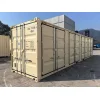
- 20 ft About 33 m³ and up to 28 t of load. Spare parts, chemicals, seed; about 20 big bags in two tiers. A truck-mounted loader moves it from field to field.
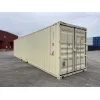
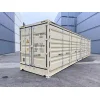
- 40 ft Up to 76 m³ in a High Cube. Fertiliser and seed for a season, long hoses and pipes, a stock of packaging.
- Reefer container A cold room of 29 or 60 m³ for vegetables, berries, meat and dairy. Runs on a 380 V supply or a generator.
Why a container rather than a building
A permanent store means a design, construction and months of time. A container arrives within days and stands on a level spot. When the crop rotation or the land lease changes, it is moved to a new place.
Steel walls and tight doors keep rain, birds and rodents away from the load. For the season you can rent a container instead of keeping it all year.
What to watch for
- Moisture. Temperature swings cause condensation in a closed container. Seed, grain and fertiliser go on pallets with a gap from the walls, and vents are fitted.
- Bulk grain. A standard container does not replace a grain store: grain is kept in bulk only with a liner and a bulkhead at the doors, and more often in big bags.
- Condition. For seed and grain, take a container with a sound, clean, odour-free floor — new or used grade 1–2. For spare parts and packaging a lower grade is enough.
- Chemicals. Crop protection products are kept in a separate container, locked and ventilated.
Prices right now
In stock at yards in Ukraine now: 20 ft — from 1 690 $, 40 ft — from 3 290 $, 40 ft reefer — from 27 900 $.
| Container | Condition | In stock | Price | View |
|---|---|---|---|---|
| 20 ft | new | 47 in Ukraine | from 3 500 $ | View |
| 20 ft | used | 82 in Ukraine | from 1 690 $ | View |
| 40 ft | new | 34 in Ukraine | from 4 490 $ | View |
| 40 ft | used | 14 in Ukraine | from 3 290 $ | View |
| 40 ft reefer | new | 1 in Ukraine | from 27 900 $ | View |
| 40 ft reefer | used | 5 in Europe and China | from 9 990 $ | View |
Prices and stock come from the catalog and are updated automatically. The price is per container at the yard; delivery is calculated separately.
All prices by type and conditionPrice delivered to your city
Containers stand at yards in the cities below; other cities are served from the nearest yard. A city page shows what is on site, the price with delivery and the lead time.
All cities Calculate delivery to your addressYou can rent instead of buying
For sowing or harvest you can rent a container: you pay for the days of use, and it is collected after the season.
Rental terms and pricesHow it works
- You choose the size and condition. Before the purchase we send photos of the actual container; you can inspect it at the yard.
- Payment: bank transfer, cash at the office or card.
- Delivery is arranged through carriers: 1–4 business days from a yard in Ukraine, usually 90–120 days by sea from China.
- The container is lifted off by a crane or a truck-mounted loader and set on a prepared level spot. It is ready to use at once.
Call or write
 Telegram
 Viber
 WhatsApp
Frequently asked questions
In stock at yards in Ukraine now: 20 ft — from 1 690 $, 40 ft — from 3 290 $, 40 ft reefer — from 27 900 $. The price depends on the size, the condition and the yard where the container stands. Delivery is calculated separately — the finder on the website shows its cost to your city.
In bags and big bags — yes, if they stand on pallets and the container is ventilated. In bulk — only with a liner and a bulkhead at the doors: the walls and doors of a standard container are not designed to be opened with grain pressing against the leaves.
The payload of a 20 ft is up to 28 tonnes, of a 40 ft about 26 tonnes. The floor is designed for a forklift, so big bags and pallets are placed by machine.
A container without a foundation is movable property, not a permanent building, and needs no building permit. It is placed on your own or leased land as equipment.
The body and doors are steel, and the doors close on a rubber seal. It is far harder for rodents to get in than into a wooden or slate shed; just make sure the seal and the floor are intact.
From a yard in Ukraine — in 1–4 business days. The delivery price depends on the distance to the nearest yard; the finder on the website shows it, and a manager confirms the exact amount to your address.