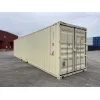
What a container gives you as a base
- Speed. The shell of the house stands on your plot on the day of delivery — no excavation, masonry or roofing.
- A strong frame. A container is designed to carry a stack of loaded containers, so a second storey goes straight on top of the first.
- Modularity. Two 40 ft units side by side give about 56 m²; the house grows as money and need allow.
- Mobility. A cabin on screw piles or blocks can be moved to another plot.
Which size to choose
- 40 ft High Cube About 28 m²: a studio with a kitchen and bathroom, a guest house, a family summer cabin. The main choice for housing.
- 20 ft About 14 m²: a summer cabin, a sauna, a utility unit, a guest cabin. Handy where a long trailer cannot get in.
- Several modules Two or three containers side by side or on two storeys make a full house. Each module is delivered and set separately.
What you need to know beforehand
- Steel is a thermal bridge. Without continuous insulation and a vapour barrier the house will be cold in winter, hot in summer and damp. Walls, ceiling and floor are insulated, and ventilation is a must.
- The width is 2.35 m inside, about 2.2 m after insulation. Spacious rooms are made by joining two containers and removing part of the wall between them.
- Openings weaken the wall. Every cut for a window or door is reinforced with a frame, and large openings with posts.
- A permanent home with an address is house construction: the rules are the same as for any dwelling. A summer or guest cabin without a foundation is usually placed as a temporary structure. Check this with an architect before buying.
Which container to take for housing
For housing, take a High Cube: it is 2.69 m inside, and after insulating the floor and ceiling a normal height of about 2.4–2.5 m remains. A standard 2.39 m container ends up low after fit-out.
As for condition, a new container is better: its history is known, the walls are straight and the floor has not absorbed cargo smells. A used grade 1 also works if you plan to replace or cover the floor. Before the purchase we send photos of the actual container.
Prices right now
In stock at yards in Ukraine now: 40 ft — from 3 290 $, 20 ft — from 1 690 $.
| Container | Condition | In stock | Price | View |
|---|---|---|---|---|
| 40 ft | new | 34 in Ukraine | from 4 490 $ | View |
| 40 ft | used | 14 in Ukraine | from 3 290 $ | View |
| 20 ft | new | 47 in Ukraine | from 3 500 $ | View |
| 20 ft | used | 82 in Ukraine | from 1 690 $ | View |
Prices and stock come from the catalog and are updated automatically. The price is per container at the yard; delivery is calculated separately.
All prices by type and conditionPrice delivered to your city
Containers stand at yards in the cities below; other cities are served from the nearest yard. A city page shows what is on site, the price with delivery and the lead time.
All cities Calculate delivery to your addressHow it works
- You choose the size and condition. Before the purchase we send photos of the actual container; you can inspect it at the yard.
- Payment: bank transfer, cash at the office or card.
- Delivery is arranged through carriers: 1–4 business days from a yard in Ukraine, usually 90–120 days by sea from China.
- The container is lifted off by a crane or a truck-mounted loader and set on a prepared level spot. It is ready to use at once.
Call or write
 Telegram
 Viber
 WhatsApp
Frequently asked questions
In stock at yards in Ukraine now: 40 ft — from 3 290 $, 20 ft — from 1 690 $. The price depends on the size, the condition and the yard where the container stands. Delivery is calculated separately — the finder on the website shows its cost to your city.
The container is only part of the budget. Delivery, supports, insulation, windows and doors, utilities and fit-out come on top — usually several times the cost of the shell itself. The contractor who does the conversion will give an exact estimate.
A continuous foundation is not needed: a container rests on its four corners. Screw piles, concrete blocks or piers are used — this leaves an air gap under the house and keeps it movable.
It is, if insulated properly: a continuous layer with no gaps, a vapour barrier on the warm side, and ventilation. This is not the place to save — poor insulation is exactly why container homes get a bad name.
You can, but choose carefully. Over years of service the floor of a used container absorbs cargo smells, so it is usually replaced or covered. If the budget allows, a new container is taken for housing.
The catalog holds containers in standard form, and the prices on this page are for the container without conversion. Tell us about the project and we will suggest which container to choose for it.