Foundation for a Shipping Container: Piles, Blocks, or Monolith — What to Choose?
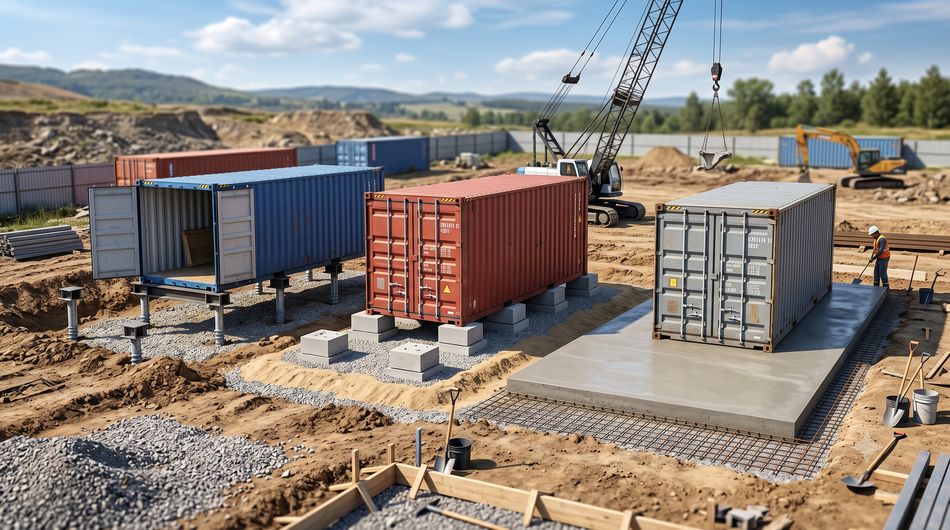
A shipping container is a heavy-duty steel structure capable of withstanding colossal loads. In port terminals, they are stacked 8-9 tiers high, and they handle it perfectly. Because of this, a dangerous misconception arises: it seems that a container can simply be thrown on the ground, and nothing will happen to it.
The reality is different: if you place a container on unprepared soil, over time the ground will sink, the geometry of the steel frame will be distorted, and the doors will stop closing. In the worst case, active corrosion of the bottom will begin.
Let's break down what kind of foundation is needed for a shipping container, what the choice depends on, and how not to spend extra money while ensuring reinforced concrete reliability.
The Main Rule of Shipping Container Installation
Before choosing the type of foundation, you need to understand the structural feature of the container: the container rests only on its four corners (corner castings).
The bottom longitudinal and transverse beams must not lie on the foundation along their entire length. First, they are not designed for this (all the load-bearing capacity is concentrated in the frame and corners). Second, if you put the container "belly" down on a strip foundation without gaps, air will stop circulating under it, moisture will accumulate, and the metal will start to rot.
4 Main Types of Foundations for a Container
The choice of base depends on three factors: the type of soil on the site, the budget, and the purpose of the container itself (temporary cabin, capital house, warehouse for heavy equipment).
1. Foundation Blocks or Paving Slabs
The simplest, fastest, and most budget-friendly option, which is perfect for temporary installation, organizing warehouses, or construction cabins.
- How it works: Concrete blocks are installed on leveled areas (ideally on a cushion of crushed stone and sand) under each of the four corners of the container. For 40-foot models, two more blocks can be added in the center of the long sides for insurance.
- Pros: Cheap, can be done by yourself in a couple of hours, easy to dismantle and transport to another facility.
- Cons: Not suitable for heaving soils. During the freezing and thawing of the ground, the blocks will "walk," which will lead to a skew of the doors.
- Budget: Minimal.
2. Screw Piles
The absolute leader in terms of price-quality ratio. An ideal option for modular homes made of containers, mobile offices, and permanent warehouses.
- How it works: Steel pipes with blades are screwed into the ground below the freezing depth of the soil (usually by 1.5–2 meters). Caps are welded on top, onto which the container fittings sit exactly.
- Pros: Installation in 1 day in any weather. The piles are securely fixed in dense soil layers, so the container is not afraid of either frost heaving or elevation changes on the site.
- Cons: Impossible to install on rocky ground. Requires anti-corrosion treatment of the piles themselves.
- Budget: Medium.
3. Strip Foundation (Shallow)
A classic solution in capital construction. It is used less often for a shipping container, mainly if a full-fledged residential house is built from it and they plan to line it with bricks or make a heavy extension.
- How it works: A reinforced concrete strip is poured along the perimeter of the container (taking into account the geometry).
- Pros: High load-bearing capacity, durability, the possibility of arranging a warm subfloor.
- Cons: Expensive, takes a long time (the concrete must gain strength), complex dismantling.
- Budget: High.
4. Monolithic Reinforced Concrete Slab
The most expensive and reliable type of foundation. It is justified in two cases: if the soil on the site is extremely poor (peat bogs, quicksand, high level of groundwater), or if the container is being converted into a garage, workshop, or warehouse for heavy machinery.
- How it works: The fertile layer is removed, a sand-and-gravel cushion is made, reinforcement is tied, and a continuous slab is poured.
- Pros: Absolute stability on any soil. The slab itself immediately serves as a ready-made, heavy-duty floor (if you cut out the native plywood floor of the container).
- Cons: Maximum cost, requires large-scale earthworks and the involvement of heavy machinery.
- Budget: Very high.
How to Choose a Foundation Depending on the Soil
To simplify the choice, we have prepared a list of recommendations based on the geological conditions of your site:
- Dry sand, rocky ground: recommended foundation — concrete blocks. A strip foundation is suitable as an alternative.
- Clay, loam (prone to heaving): recommended foundation — screw piles. An alternative option for a large budget is a monolithic slab.
- Swampy area, peat bog: deep-laid screw piles are strongly recommended. An expensive alternative is a floating monolithic slab.
- Site with a strong slope: screw piles of different lengths will be the optimal solution. As a backup option, you can consider a stepped strip foundation.
Expert advice: In coastal areas, where sandy soils mixed with clay and a high level of humidity are often found, screw piles perform best. They raise the metal bottom of the container above the damp ground, providing excellent ventilation and protection against rust.
Main Installation Mistakes to Avoid
- Installation directly on the ground. Even if the soil seems solid, over time it will sink under the weight of the container. The metal will begin to contact moisture, which will inevitably lead to through-corrosion.
- Rigid welding to the foundation unnecessarily. If the container is used as a temporary warehouse, do not weld its fittings to the piles tightly — a bolted connection is enough. This will greatly simplify life when moving.
- Ignoring the level. If the diagonal difference is at least 1-2 centimeters, the heavy doors of the container will jam, and the native seals will stop providing tightness.


