Protecting a shipping container from professional break-ins
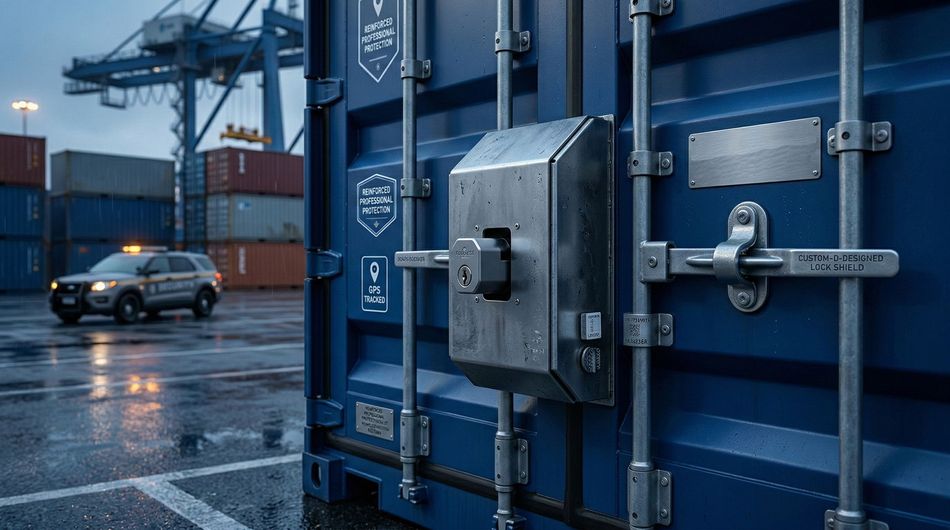
Ten, twenty, or thirty tons of alloy steel inspire genuine respect. When you stand next to this corrugated colossus, it seems that it can only be opened with a tank shell or an industrial plasma cutter. That is why business and private individuals love to use port containers as warehouses for expensive tools, generators, ATVs, and scarce building materials. But let's face the truth: intruders rarely arrive with a heavy gas cutter to spectacularly saw through thick Corten steel in front of an astonished public. They always take the path of least resistance.
And the weakest link in any impregnable fortress is its gates. The question "how hard is it to break into this box?" sounds from practically every second client who takes a module for a warehouse. The answer is simple and harsh: exactly as hard as your locks and access control systems are reliable.
Mechanics versus a crowbar: why an ordinary padlock is a gift to thieves
The native hardware of a shipping container is a massive system of vertical bars and cams. It is designed ingeniously: when you turn the powerful handles, the cams bite tightly into the grooves on the frame, pressing the doors so tightly that not even seawater under storm pressure gets inside. But all this engineering beauty in the basic configuration is fixed with simple padlocks on the handle eyelets.
If you hang a regular, even the most expensive and massive padlock with an open shackle there, you simply invite robbers to enter. In the conditions of a deserted industrial zone, construction site, or country village in the off-season, such a shackle is bitten through with long hydraulic scissors (bolt cutters) in exactly three seconds, and absolutely silently. No ringing of metal, just a light click — and the doors are open.
How is this cured? By installing a so-called "lock box" — an anti-vandal hidden lock. This is a special steel casing that is welded right onto the door leaves. A special disc or U-shaped lock is placed inside this casing. It is physically impossible to reach its shackle with bolt cutters or a crowbar — it is completely hidden under a thick layer of metal. To saw off the lock box itself, intruders will need a powerful angle grinder, a bunch of cutting discs, an autonomous generator, and about twenty minutes of time, accompanied by a fountain of sparks and a wild howl all over the district. They would only go for this in a Hollywood movie; in reality, thieves will simply turn around and go looking for easier prey.
Digital watchman: how to bypass the Faraday cage effect
But what if your warehouse is located where the noise of an angle grinder won't bother anyone? This is where modern monitoring technologies come to the rescue. Many owners of valuable cargo want to know exactly when the doors of their iron vault open.
The main problem of any metal box is the Faraday cage effect. Steel walls tightly jam any radio signals, so throwing a cheap GPS tracker from a marketplace on a shelf and hoping for a miracle won't work — it will simply lose the network and turn into a useless piece of plastic.
Specialized autonomous bookmark trackers are used for such tasks. Firstly, they are attached to powerful neodymium magnets directly to the ceiling or wall (no drilling or loss of tightness). Secondly, they are installed as close to the doorway as possible — where the rubber seals leave a small radio-transparent gap for the passage of a GSM signal.
Modern security systems can react not only to a change in coordinates. They are equipped with highly sensitive light sensors (triggered as soon as the sash opens and at least one ray of light falls inside), accelerometers (react to a strong impact or vibration if someone tries to cut the hinges or drill the lock), and surface detachment sensors. In the event of any abnormal event, the device instantly comes out of sleep mode and sends an alarming push notification or SMS to the owner's phone. The battery in such a watchman is enough for several years of autonomous work, since in normal mode it gets in touch only once a day to sparingly report: "I'm alive, the coordinates are the same, the doors are closed."
The final line of defense
Security is always a comprehensive approach. By itself, the container gives you a perfect, impenetrable perimeter that cannot be broken with a sledgehammer or rammed by a passenger car. Your task is to competently close the only breach. A combination of a welded-on lock box with a hidden lock and an autonomous tracker with a light sensor hidden inside turns standard port packaging into a real safe.


