Shipping Containers Under Total Autonomy: Integration with Solar Panels
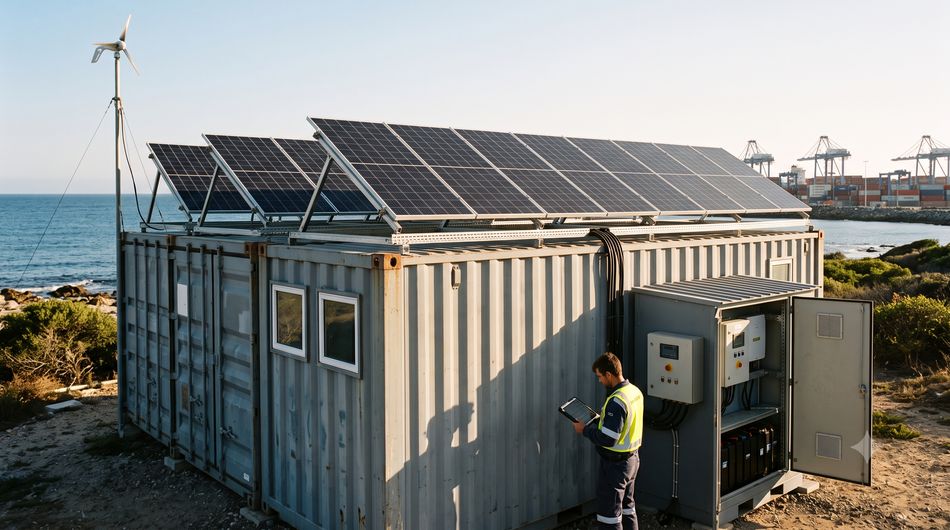
Using shipping containers as a base for remote facilities is a trend that has long gone beyond temporary cabins. Today, they are used to create autonomous workshops, apiaries, field laboratories, warehouses with automated inventory tracking, and fully fledged living modules.
The main challenge for such facilities is power supply. Pulling a stationary power grid into a field, forest, or an unequipped plot is long and expensive, and constantly burning fuel in a generator is noisy and economically unprofitable. A logical and eco-friendly solution is the creation of a solar power plant (SPP) right on the roof of the container.
Containers have a huge advantage for SPPs: a rigid flat roof, a durable steel frame, and a guaranteed usable area. Let's look into how to correctly calculate, choose, and mount an autonomous solar station for 20- and 40-foot modules.
Step 1. Assessing the Usable Roof Area
Before buying equipment, you need to understand how many panels can physically fit on the metal roof.
- 20-foot container: has roof dimensions of approximately $6.06 \times 2.44$ meters. The usable area is about 14.7 sq. m.
- 40-foot container: roof dimensions are $12.19 \times 2.44$ meters. The usable area is about 29.7 sq. m.
Modern monocrystalline solar panels with a capacity of 400–450 W have a standard size of approximately $1.72 \times 1.13$ meters (about 2 sq. m).
- On the roof of a 20-foot container, you can comfortably accommodate 6 panels (with a total capacity of about 2.4–2.7 kW).
- On the roof of a 40-foot container, up to 12–14 panels will fit (with a total capacity of 4.8–6.3 kW).
Step 2. Calculation of Energy Consumption (What Will the Station Run?)
For total autonomy, it is critically important to calculate the daily consumption balance. The station on the container must not just power appliances during the day, but also have time to charge the batteries for the dark time of the day or cloudy days.
Here is an approximate calculation of the capabilities of a station based on a 20-foot container (about 2.5 kW of installed panel capacity is available) for different types of facilities:
Remote Warehouse
- Main consumers: LED lighting, laptop, router, CCTV camera, alarm system.
- Daily consumption: about 1.5–2 kWh.
- Verdict: With a surplus. The station will fully cover the needs of the facility even in the winter period.
Workshop or Apiary
- Main consumers: Lighting, charging power tools, short-term switching on of machine tools, honey extractors, or a compressor (with a capacity of up to 1.5 kW).
- Daily consumption: about 3–4 kWh.
- Verdict: Just enough. In the summer months, there will be more than enough energy, but in autumn and winter, you will have to maintain an economic mode or periodically connect a generator.
Living Module or Field Office
- Main consumers: Mini-fridge, light, charging gadgets, a small pump station, short-term use of a kettle or microwave.
- Daily consumption: about 4–6 kWh.
- Verdict: Excellent for the warm season. In spring and summer, autonomy will be complete. However, in winter, alternative heating (wood, gas, or liquid fuel) will be required, since the SPP will not run an air conditioner or electric heater autonomously.
Step 3. Selecting Autonomous System Components
To create an "off-grid" system (total autonomy), you will need a standard set of equipment that is placed inside the container itself:
- Solar panels (PV modules): Monocrystal, preferably with Half-Cut technology. They work more stably under partial shading — for example, if a shadow from a tree or a neighboring building falls on the edge of the roof.
- Inverter: A hybrid or autonomous inverter with a pure sine wave is needed so as not to damage the sensitive electronics of the tool, pump, or boiler. For a 20-foot container, an inverter of 3–3.5 kW is optimal, for a 40-foot one — 5–6 kW.
- Battery storage (Accumulators): Lithium iron phosphate batteries (LiFePO4) are categorically recommended. They are more expensive than car or gel batteries, but withstand up to 4000–6000 discharge cycles (compared to 500 for gel), are not afraid of deep discharge, and are absolutely safe for enclosed spaces, as they do not emit gases. For a basic living module on 24V or 48V, a capacity of at least 100–200 Ah will be needed.
Step 4. Features of Installation on a Steel Roof
Mounting an SPP on a shipping container has its own specifics related to the properties of the metal. The container heats up severely in the sun and is subject to wind (sail) loads.
1. Creating a Ventilation Gap
Panels must not be mounted tightly to the roof metal. Under strong heating, solar panels lose efficiency (by about 0.4% for every degree above the standard 25 °C). In addition, the scorching roof of the container will turn the internal space into an oven. There must be an air gap of at least 10–15 cm between the panel and the roof for natural cooling by air currents.
2. Fastening Without Violating Tightness
The container roof is made of profiled steel with a thickness of only 1.5–2 mm. Screwing self-tapping screws directly into it is a direct path to leaks in half a year.
- The correct option: Use a special aluminum profile (railings) and fix them to the upper longitudinal beams of the container (channels), which are significantly thicker than the roofing sheet. The fixation points must be treated with roofing polyurethane sealant.
- An alternative without drilling: Welding mounting studs or corners to the power frame (upper ribs) of the container. The supporting aluminum frame under the panels is then bolted to them.
3. Tilt Angle
If the container stands stationary, it is better to mount the panels not strictly horizontally, but at an angle to the south side (for the northern hemisphere). The tilt angle depends on the geographical latitude (for example, for the south of Ukraine, the optimal angle for summer is ~30–35°, for winter — ~60°). Inclined installation also solves the problem of self-cleaning: rain will wash away dust, and snow will not linger on the panels in winter.
Safety and Operational Checklist
- Temperature Mode for Electronics: The inverter and LiFePO4 batteries must not be placed in an unheated or unventilated area of the container. At temperatures below 0 °C, lithium batteries are prohibited from charging, and at temperatures above 40 °C, the inverter electronics will go into protection mode. Allocate an isolated, insulated compartment with forced ventilation for the equipment.
- Grounding: A shipping container is a huge metal conductor. The panel frames, the rack, and the container itself must be combined into a common grounding loop. It is also mandatory to install lightning protection (SPD) in the DC circuit from the panels to the inverter.
- Backup: For fully autonomous systems, always budget for a small 1.5–2 kW inverter gasoline generator. It will save the system if prolonged autumn bad weather or snowfall lasts for a week, and the BMS board (battery management system) disconnects the batteries due to critical discharge.


