How to cut windows and doors in a shipping container without collapsing its roof: main mistakes and reinforcement rules
The idea of converting a shipping container into a country house, office, or stylish coffee shop looks deceptively simple. It would seem: we take a grinder or plasma cutter, cut out openings of the required size, insert double-glazed windows — and it's done.
In practice, it is at this stage that most critical mistakes are made, leading to a sagging roof, jammed doors, and deformation of the entire module. The problem is that a container is built quite differently from a regular frame house. Let's figure out how not to kill the load-bearing capacity of a steel box when cutting openings and where a welding machine is vitally necessary.
The Secret of Strength: Why a Container is Not Just a Box with a Frame
The main misconception among beginners is that a container supposedly has a rigid internal skeleton on which the iron sheathing is simply hung. This is not true.
A shipping container is a frameless structure (monocoque). Its fantastic strength, allowing loaded boxes to be stacked nine tiers high, is achieved through the profiled steel sheet on the walls. It is these "waves" (corrugations) that work as dozens of vertical stiffening ribs. They take the load from the roof and transfer it to the lower base.
As soon as you cut a piece of metal the size of a window out of this wall, you literally knock the support out from under the roof. The load is redistributed incorrectly, and the metal begins to "play".
Mistake No. 1: Opening Without Steel Edging (Strapping)
The most common scenario: a person cuts a rectangle in the wall and immediately tries to install a plastic window there using mounting foam and self-tapping screws.
What will happen: In winter, under the weight of snow or even simply from its own weight, the roof in this place will sag. The double-glazed window will, at best, stop opening, and at worst, crack due to the pressure of the metal on the frame.
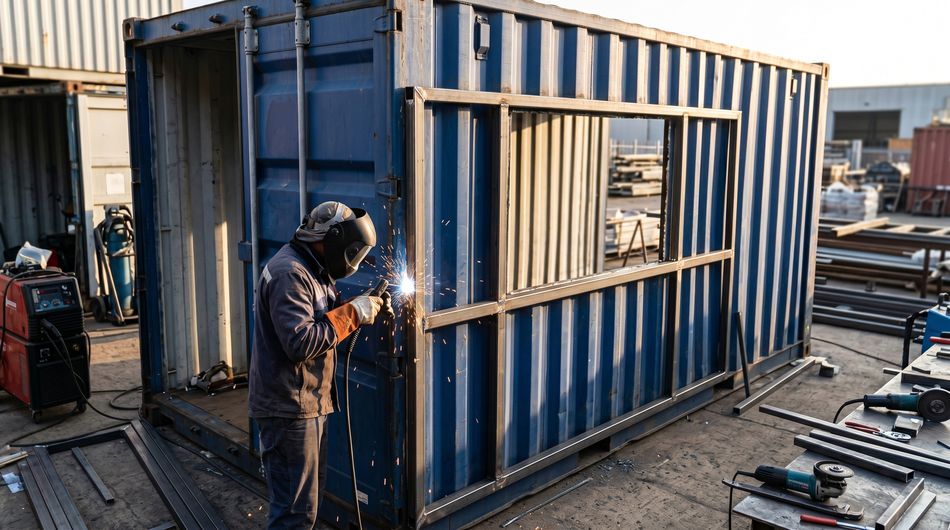
How to do it right: Any opening in a container — be it a small window or a panoramic window — requires welding a rigid contour. A frame made of steel profile pipe (usually a cross-section of 40x40, 40x60, or 50x50 mm with a wall thickness of 2-3 mm) must be welded around the perimeter of the cut hole. This frame takes on the load that the cut-out corrugation used to bear and transfers it to the remaining parts of the wall.
Mistake No. 2: Damaging the Top and Bottom Beams
Powerful longitudinal beams (top and bottom strapping) run along the perimeter of the container's roof and floor. Sometimes, to install tall, floor-to-ceiling storefront windows or entrance groups, inexperienced craftsmen decide to cut off part of this beam.
What will happen: This is a direct violation of structural integrity. The container will lose longitudinal rigidity. When trying to lift such a box with a crane or load it onto a manipulator, it will simply fold in half at the cutout site like cardboard.
How to do it right: If the project requires the removal of part of the bottom beam (for example, for an even entrance without a threshold), a powerful channel or I-beam must be welded under the floor, which will restore the broken load chain. It is strictly not recommended to touch the top beam. Windows and doors should be designed so that their upper edge is at least 5–10 centimeters below the roof beam line, where the profile pipe lintel will lie.
Mistake No. 3: Incorrect Work with the Metal Wave
The container wall is ribbed. When you attach a flat square frame from a profile pipe to it, you inevitably get through "teeth" — voids in the places of the corrugation depressions.
What will happen: If these voids are simply filled with mounting foam or smeared with sealant, water will begin to flow there in a couple of seasons, rust will appear, and cold bridges will form. The foam will collapse from ultraviolet light and vibrations (if the container is to be transported).
How to do it right: The metal reinforcing frame must be welded with a continuous seam. Where the profile pipe does not fit tightly against the metal due to a depression, it is necessary to cut out and weld small steel plug-triangles (or rectangles), closing the contour tightly. Only after this are the seams cleaned, primed, and painted, creating an ideal sealed base for installing a double-glazed window.
Golden Rule: Frame First, Then Cutout
Professionals rarely cut out the entire opening all at once. If a large panoramic window is to be made, the algorithm looks different:
- The contour of the future window is marked on the wall with a marker.
- Only cuts along the perimeter are made with a grinder so that a steel profile pipe can be inserted.
- The reinforcing frame is welded directly into the wall while the metal inside it is still in place. This ensures that the container does not "warp" from welding and loss of rigidity.
- And only when the rigid contour is ready, the inner piece of the wall is carefully cut out.
A container will endure any design fantasies, from huge display windows to complex entrance groups. The main thing is to treat it not as an iron box, but as an engineering structure where every cut-out element must be compensated with strong steel and a competent weld seam.


