The Life Cycle of a Shipping Container: How Long It Sails and What Happens to It Next
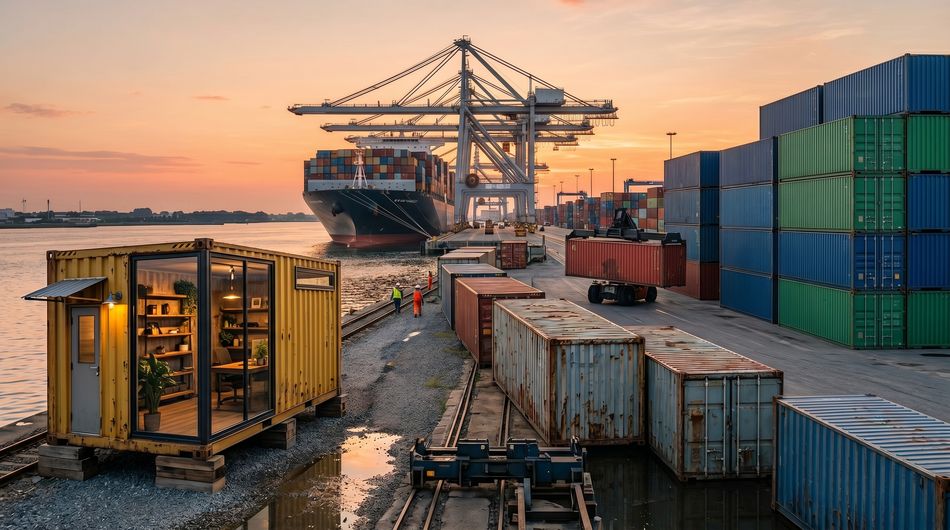
We are used to seeing them everywhere: on freight train platforms, in ports, at construction sites, and even on the streets as stylish coffee shops. It seems that this iron box simply exists outside of time. But every shipping container has its own biography, expiration date, and a quite predictable finale.
Let's figure out how long a standard dry bulk container actually lives, why shipping companies get rid of them, and how the massive industry of their resale is structured.
Maritime Career: Harsh Routine and Salt Water
A container's life begins at a factory — mostly in China, which produces the lion's share of all global packaging today. A brand new box, smelling of fresh paint, receives its unique number, a CSC plate (Convention for Safe Containers — a kind of passport), and sets off on its first voyage.
On average, the active phase of a shipping container's life lasts from 10 to 15 years. It doesn't sound very impressive for a box made of the strongest Corten steel, does it? But imagine the operating conditions. The container spends these 10-15 years in an aggressive environment: salty sea air, constant temperature changes, and storms.
It is constantly overloaded by port cranes, stacked eight to nine high (which is a huge load on the lower tiers), and it shakes on trucks and railway platforms. Gradually, dents from careless forklift handling appear, scratches show up, rust begins to form, and the rubber seals on the doors wear out.
Why Are They Decommissioned If They Are Still "Good to Go"?
Decommissioning a container is not always a story about a rusty sieve that is about to fall apart. Most often, the reason lies in strict international standards and simple economics.
First, every container undergoes regular inspections. If the geometry is compromised, the fittings (corner castings) are deformed, or the bamboo plywood floor is rotted, such a box will not be allowed on a ship. It is simply unsafe for the entire stack. Repairs sometimes cost more than the residual value of the container itself.
Second, in logistics, there is a concept known as the imbalance of cargo flows. Goods travel massively from Asia to Europe and the US, and it is unprofitable for shipowners to send empty containers back — transporting "air" is expensive. Therefore, it is often easier for shipping lines to sell accumulated used containers at the port of destination at a reduced price and order new boxes in China.
A Second Life on Land: The Global Resale Market
When a container "goes ashore" forever, it enters the secondary market. And here the most interesting part begins, because the resale industry is huge and clearly segmented.
All decommissioned containers receive new statuses:
- One Way. These are practically new containers. They were built in Asia, loaded with goods, brought to Europe (for example), and immediately sold. They have perfect geometry, no rust, and at most — a couple of scratches. This is the most expensive segment.
- WWT (Wind and Water Tight). The very "veterans" that have served their 10-15 years. Yes, they are scuffed, with patches on the walls, but they perform their functions perfectly — moisture does not get inside. These are most often purchased for warehouses.
- AS IS. Containers with serious defects. Doors may close with difficulty, and there may be through holes. They are taken for deep reconstruction or as temporary sheds for construction.
It is during the "second life" stage that shipping containers turn into modular homes, mobile offices, tire fitting shops, and garages. Thanks to the safety margin of Corten steel, such a box can stand on land for another 20–30 years without requiring special attention, except for periodic tinting.
Terminal Station: Scrap Metal and Smelting
Nothing lasts forever. Sooner or later, the moment comes when the container is eaten away by corrosion, or it receives such damage that it makes no sense to restore it even to use as a shed.
Then its journey ends at a scrap metal collection point. A standard 20-foot box is more than two tons of high-quality steel, and a 40-foot one weighs almost four tons. The metal is cut into pieces, pressed, and sent for smelting.
And who knows, maybe some of the steel from the old container that carried electronics from Shanghai to Rotterdam for decades will go into the production of your new car's body or rebar for building a house. The circle closes to start anew.


