Mobile Data Center: Why the IT Sector is Massively Buying Up Shipping Containers
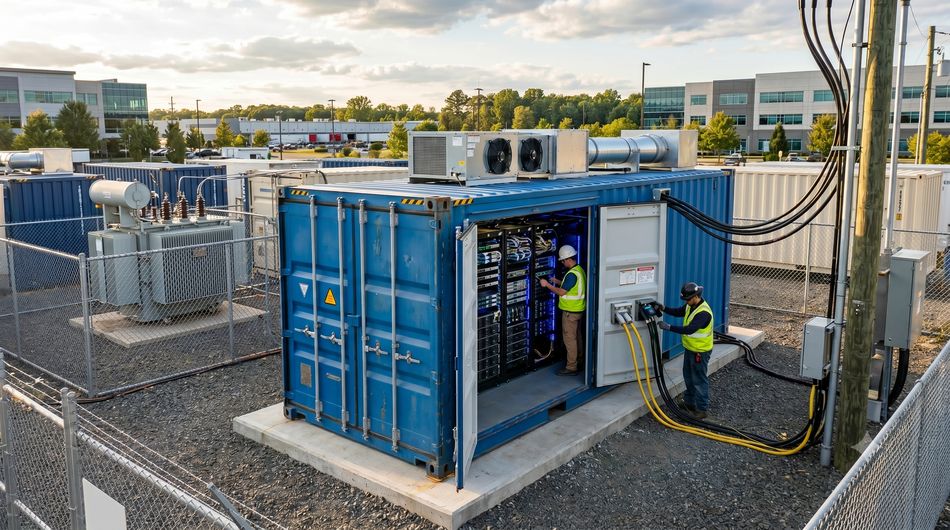
In the era of rapid development of artificial intelligence, cloud computing, and the Internet of Things (IoT), the volumes of processed data are growing exponentially. To cope with this load, IT companies need new server capacities. However, building a classic capital data center is a long, expensive, and not always justified process.
In search of an alternative, the IT sector turned to logistics. It turned out that a standard shipping container (High Cube 20 or 40 feet) is an ideal blank for creating a powerful, autonomous, and mobile data center (DC).
Let's break down why containerized server rooms have become a global trend and what tasks they solve more efficiently than traditional buildings.
What is a Container Data Center and What is the Essence of the Trend
A mobile data center (MDC) is a full-fledged server room assembled inside a steel shipping container. It is delivered to the customer in a "plug-and-play" state. Server racks, uninterruptible power supply systems, precision air conditioners, gas fire extinguishing, and access control systems are already installed inside.
The trend was set by tech giants like Google, Microsoft, and Sun Microsystems back in the late 2000s. Today, this technology is available not only to corporations but also to medium-sized businesses: telecom operators, industrial enterprises, crypto farms, and scientific institutes. The main reason for such popularity lies in three key advantages: scaling speed, efficient cooling, and mobility.
Solving the Business Scaling Problem
Building a classic data center takes from one to three years. During this time, technologies move forward, and business needs can change dramatically. The container approach changes the rules of the game.
- Fast deployment: Assembly and testing of the MDC at the factory takes a few weeks. At the customer's site, it only remains to prepare the foundation, connect the power, and the communication channel.
- Modular architecture: If a company lacks capacity, it simply buys another container and places it next to the first one. The infrastructure grows in blocks according to real need.
- Predictable budget: The cost of the container solution is known in advance. There is no risk that the estimate for capital construction will double due to unforeseen expenses, contractor delays, or the rise in the price of building materials.
Extreme Equipment Cooling
The main enemy of any server is overheating. In classic buildings, organizing correct airflows is often fraught with architectural difficulties. In a shipping container, space is limited, which paradoxically makes cooling more predictable and efficient.
- Flow separation: Inside a narrow container, the principle of strict isolation of "cold" and "hot" aisles is easily implemented. Cold air is supplied strictly to the front panels of the servers, and the heated air is discharged through the back walls.
- Precision air conditioners: Industrial climate systems are installed in the MDC, which maintain temperature and humidity with an accuracy of up to a degree.
- Free Cooling: In cold regions, the system can draw in filtered outside air for the natural cooling of equipment, which reduces energy costs by tens of percent.
- Liquid cooling: For the densest and hottest computing systems, compact water or immersion cooling systems are integrated into the containers, which are difficult to deploy in ordinary office buildings.
Infrastructure Mobility and Edge Computing
Data needs to be processed where it is generated. This concept is called Edge Computing. The MDC fits perfectly into this philosophy, allowing you to bring the server room to the data source, and not vice versa.
- Work in hard-to-reach places: Containers are installed on oil rigs, in mining quarries, at military bases, and remote industrial facilities where there is no stable broadband connection to the cloud, but local computing power is acutely needed.
- Quick relocation: If an enterprise moves to another region or a land lease agreement expires, the data center moves with it on a regular container ship, without requiring the dismantling of racks.
- Redundancy and security: In the event of natural disasters, blackouts, or the threat of physical damage to the facility, the mobile DC can be quickly transported to a safe zone, saving critical information and hardware.
Comparison of Classic and Container DC
To visually assess the advantages of the modular approach, let's compare both options by key characteristics:
- Launch times: building a capital structure takes from 1 to 3 years, while a mobile data center can be launched in just 4–12 weeks.
- Scaling: for a traditional server room, this is a complex process requiring an initial reserve of space. A container DC scales easily and block-by-block — by simply adding new modules.
- Mobility: a capital building is permanently tied to a location, while a container has high mobility and is transported by regular logistics transport.
- Site requirements: the classic option requires permits for capital construction and the pouring of a deep foundation. For an MDC, a flat area, screw piles, or concrete blocks are sufficient.
- Power density: in ordinary buildings it remains standard, and in container solutions, due to the strict isolation of airflows, it reaches the highest possible indicators.


