Container Insulation: Inside vs Outside
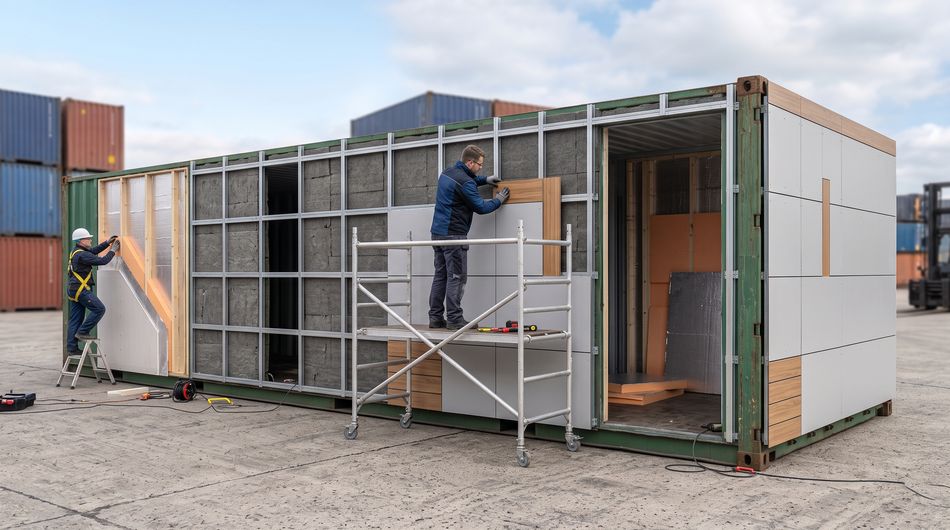
A shipping container is a sealed steel box. Metal has high thermal conductivity: in summer it heats up, turning the interior into an oven, and in winter it freezes instantly, covered inside with frost and condensation.
Proper insulation is the only way to transform a container into a comfortable living space, office, or heated warehouse. Let's analyze the physics of the process, the choice of installation side, and key materials.
Inside or Outside: Where to Install Thermal Insulation?
The choice of insulation side determines the physics of the entire structure's operation.
- Insulation from the Outside (Optimal Choice): The dew point is moved outside the steel wall into the insulation layer, 100% of the useful internal volume is preserved, and the steel body is protected from temperature swings and corrosion. Drawbacks: requires a finished facade cladding (siding, corrugated sheet) to protect against UV radiation and precipitation.
- Insulation from the Inside (Forced Solution): Used when external dimensions or appearance cannot be altered. The main risk is that the steel wall remains cold: when moist air penetrates through the insulation, moisture forms on the metal, leading to corrosion and rotting of the framing. It also reduces the usable area by 10–15 cm on each side.
Detailed Breakdown of Insulation Materials
1. Spray Polyurethane Foam (SPF)
Closed-cell SPF is considered the best technological choice for a steel container, especially when installed from the inside.
- Working Principle: Foam is applied under pressure, fills all corrugation waves, and instantly adheres to the metal.
- Thermal Conductivity: Very low (~0.022 W/m·K).
- Vapor Permeability: Virtually zero. Due to the lack of an air gap between the metal and foam, moisture physically cannot reach the steel, and the dew point ends up inside the foam layer.
- Space Loss: Minimal (a layer of 5–7 cm is sufficient).
- Fire Hazard: Class G3–G4 (combustible, produces smoke; grades with fire retardant additives reach G2/G1 classes but cost more).
- Contour Quality: 100% seamless monolithic coating without thermal bridges.
- Installation Complexity: High (requires professional equipment and a specialized crew).
2. Mineral (Basalt) Wool
A classic material for frame construction, requiring strict compliance with technology.
- Working Principle: Placed into the cells of a wooden or metal frame.
- Thermal Conductivity: Medium (~0.038–0.042 W/m·K).
- Vapor Permeability: High. Mineral wool easily absorbs moisture, so internal insulation requires an absolutely airtight vapor barrier layer with all seams taped. Without this, the insulation will get wet, lose its properties, and cause metal corrosion.
- Space Loss: Maximum (10–15 cm layer plus load-bearing frame).
- Fire Hazard: Class G1 / NG (completely non-combustible material). Ideal for rooms with elevated fire safety requirements, such as boiler and generator rooms.
- Contour Quality: Joints between slabs create a risk of thermal bridges forming.
- Installation Complexity: Medium (requires constructing a frame and installing a vapor barrier membrane).
3. Extruded Polystyrene Foam (XPS)
A board material featuring high strength and low hydrophobicity.
- Working Principle: Boards are glued to the walls and fixed to the framing.
- Thermal Conductivity: Low (~0.030–0.034 W/m·K).
- Vapor Permeability: Low. The material is resistant to moisture, retains its shape, and is easy to install yourself.
- Space Loss: Medium (8–10 cm layer).
- Fire Hazard: Class G3–G4 (highly flammable, melts releasing toxic substances).
- Contour Quality: The wavy shape of the container walls creates air pockets behind the flat board, so all gaps and board joints must be thoroughly filled with spray foam.
- Installation Complexity: Low (suitable for DIY installation using adhesive foam).
Summary and Recommendations
- If budget and conditions allow: Install external insulation using any material along with a ventilated facade setup.
- If insulating from the inside yourself: Use XPS or spray polyurethane foam in cans for small areas to reduce the risk of condensation.
- If fire safety is the priority: Choose mineral wool, but devote 90% of your attention to the quality of the vapor barrier film installation.
- If maximum space and speed are needed: Order professional closed-cell SPF spraying with a thickness of 50–70 mm.


